
Specialized Program in “Sexuality and Sexual Disorders Therapy”
Sexuality often comes up in a psychotherapist’s office. But not explicitly.
A client may seek help due to relationship difficulties, anxiety, loneliness, physical tension, lack of desire, jealousy, infidelity, an inability to form intimate relationships, a feeling of being “wrong,” or repeated failures in relationships.
And only later does it become clear that a significant portion of these experiences is linked to sexuality, physicality, identity, shame, arousal, taboos, or early relationship experiences.
Sexuality lies at the intersection of many processes:
body + personality + identity + attachment + family history + relationships + culture + fantasies + taboos + individual experience.
Therefore, it is not enough for a professional to simply study a list of sexual disorders. It is essential to understand the person to whom that sexuality belongs.
The Program’s Core Professional Value
This specialization develops the therapist’s ability to address sexual issues without moralizing, pathologizing, or attempting to force the client into a specific, universal sexual “norm.”
Upon completing the program, the professional will have acquired a repertoire of effective techniques and the professional freedom to work with sexuality.
This is the ability to sustain a conversation about the body, desire, arousal, lack of desire, fantasies, infidelity, identity, shame, and unusual sexual experiences—without panic, peeping-tom curiosity, or hasty diagnoses.
Because behind every sexual symptom there is always a person.
And one of the most important goals of psychotherapy is not to help them become “normal,” but to help them better understand their own sexuality, make choices more freely, and build relationships with themselves and others based on awareness, consent, and responsibility.
The program’s central focus is: How is this person’s sexuality structured, what story are they telling, and what is preventing them from living freely and responsibly in connection with their body, their desires, and another person?
This program will be useful for:
- Practicing psychologists and psychotherapists
- Couples who want to have long-lasting and intimate sexual relationships, regardless of age or marital status
- Social workers and educators who work with adolescents and children from troubled families
- Parents who want to raise mentally and psychologically healthy children and support them through puberty
- discuss sexuality with clients more freely and professionally;
- explore the development of sexual and gender identity;
- recognize the influence of the family of origin and separation;
- work with sexual shame and taboos;
- use the Gestalt approach when working with sexual issues;
- explore the cycle of sexual contact;
- work with sexual difficulties in couples;
- address the issue of infidelity;
- explore sexual fantasies;use
- bodily metaphors;
- better distinguish between variations in sexuality and clinically significant disorders;
- adhere to professional and ethical boundaries;
- recognize one’s own countertransference;
- understand the limits of one’s competence;
- develop a therapeutic strategy that takes into account the client’s personality, body, relationships, and life history.

Psychologist, Certified Gestalt Therapist, Certified Supervisor, Group Therapist, Accredited Leading Trainer of MIGIS, Specializes in working with couples and families, Specializes in sexuality issues, Uses body-oriented therapy in her work, Member of EAGT, Member of ССРА (Canadian Counseling and Psychotherapy Association).
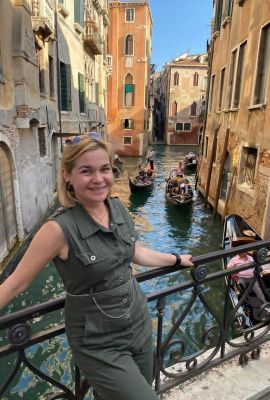
Співорганізатор, адміністратор проекту і його жива енергія.
Та людина, з якою все складається легко, навіть якщо спочатку здається складним.
Сімейний психотерапевт.
Працює з темами близькості, сексуальності та стосунків у гештальт-підході. Ведуча груп.
Про чесність, задоволення та живий контакт.
Вважає, що близькість починається там, де можна бути собою —
іноді смішним, іноді незручним, але справжнім.
A specialised program is training that:
- Deepens knowledge in a specific field (for example: trauma work, body therapy, child psychotherapy, supervision, crisis states, etc.),
- Adds practical skills for working with particular cases,
- Is often part of a professional development path or an extension of the main therapeutic education.
The volume of a Specialised Program is no less than 120 academic hours.


